
Building a Strategic Plan That Gets Used
Quick Links: Building a Strategic Plan that gets used What is the role of a Strategic Plan? From discussion to direction What should a Strategic Plan achieve? How does DNS Specialist Services facilitate Strategic Planning? Why use an external Strategic Planning facilitator? Building a Strategic Plan that gets used Contact DNS SS for more information Building a Strategic Plan That Gets Used Clubs and hospitality venues are planning for the future in an increasingly complex environment. Operating costs continue to rise. Member and customer expectations are changing. Communities are evolving and competition for people’s time and spending is increasing. At the same time, Boards are being asked to make significant decisions about facilities, investment, financial sustainability, governance and the future position of their venue. These decisions cannot be made in isolation. A well-developed Strategic Plan turns those conversations into agreed priorities, measurable goals and a clear framework for future decision-making. Where should the venue be positioned in three, five or ten years? Which opportunities should be prioritised? Where should the venue invest? What needs to change to remain relevant to members and the broader community? What is the role of a Strategic Plan? A Strategic Plan sets the organisation’s future direction and priorities. It helps maximise future opportunities, respond to change and minimise the risk of lost opportunities. Importantly, it provides continuity and consistency in direction, reducing the risk of major strategic shifts when Board members change. It gives management clear guidance on the organisation’s priorities and should be reviewed at least every two years to ensure it remains relevant. The Board sets the direction. The Strategic Plan maintains the direction. Management delivers it. Importantly, a Strategic Plan is different from an operational plan. The Strategic Plan establishes the organisation’s direction and Board-level priorities. The Operational Plan then sets out how management and individual departments will develop specific marketing, loyalty, service and community initiatives to support that direction. This connection between strategy and operations is critical. Without it, departments can be busy delivering projects and activities without a clear understanding of how their work contributes to the venue’s broader goals. Strategic Plan Establishes the direction and priorities. Focus on Membership growth & engagement. Management develops specific marketing, loyalty and service initiatives to support the direction. Operational Plan Takes the strategic goal and turns it into action – specific initiatives, responsibilities, timelines and measurable targets for management and each department. From discussion to direction Most Boards and management teams are not short of ideas. There are often many opportunities and challenges at hand all at the same time. The challenge is deciding which priorities matter most. Without a structured Strategic Planning process, discussions can move between competing ideas without reaching clear agreement. Immediate issues can take over the conversation, longer-term decisions can be deferred and individual priorities can begin to pull the organisation in different directions. A Strategic Plan brings these discussions together. It creates the opportunity for the Board and Management team to step away from day-to-day matters, consider the bigger picture and agree on the venue’s future direction. Venue Opportunities Refurbish facilities Reposition the Venue Improve Memberships New revenue Streams Strengthen Governance Invest in Technology Venue Challenges Financial performance Changing Demographics Ageing Facilities Community Relevance Internal Conflicts Plan Execution issues The value of a Strategic Plan is not the document, but the clarity, alignment and decision-making framework created through the planning process. What Should a strategic plan achieve? A practical Strategic Plan should help your venue: Define its long-term direction and desired future position Establish a small number of clear strategic priorities. Align the Board and management team around shared goals. Guide major decisions, investment and resource allocation. Balance financial, member, community and operational considerations. Set measurable objectives for monitoring progress. Give management a framework for developing operational and departmental plans. Communicate the organisation’s direction throughout the wider team. Rather than considering every proposal as a separate decision, the Board can ask whether the opportunity supports the agreed strategic direction, which priority it contributes to and whether it should take precedence over other investments. This creates greater consistency and discipline around decision-making. How does DNS SS facilitate strategic planning? DNS Specialist Services works with Boards, committees and management teams to develop practical Strategic Plans for clubs and hospitality venues. The process is tailored to the individual venue, its current position and the decisions it needs to make. It generally includes preparation and research, followed by a focused one or two-day Strategic Planning workshop. Our facilitators bring structure, objectivity and hands-on industry experience to the process. We guide the discussion, challenge assumptions where needed and help the group move from broad ideas towards agreed priorities and measurable goals. The workshop may explore: The purpose is not to create an unrealistic wish list. It is to establish a clear and achievable direction that reflects the venue’s ambitions, resources and commercial realities. Following the workshop, DNS prepares a Strategic Planning Report outlining the agreed direction, strategic priorities, goals and recommended measures. This gives the Board a clear framework for future decisions and gives management the direction required to develop supporting operational plans. Why use an external planning facilitator? An experienced external facilitator can help: Keep the workshop focused on strategic rather than operational matters. Ensure different Board and management perspectives are heard. Challenge assumptions and test the thinking behind proposed priorities. Provide an independent perspective on the venue’s position. Contribute broader insights from across the club and hospitality industry. Turn broad ambitions into clear priorities and measurable goals. Establish a practical structure for accountability and future reporting. Because DNS works across Strategic Planning, Governance, Gaming, Membership, Loyalty, Marketing, People and Culture, Systems and broader venue operations, we understand how Board-level decisions affect the entire organisation. We also understand that a strategy must work beyond the boardroom. It needs to guide decision-making, provide direction for management and create a clear connection between the venue’s long-term goals and the work being delivered throughout the business. Building a strategic plan that gets used A successful Strategic Plan does
Your Venue Is Busy. But Is It Profitable?

A full car park, a busy bistro and an active gaming floor can make a venue appear successful. But activity does not always equal profitability. Australian clubs and pubs are operating in a tighter market. Costs have increased. Operational planning helps a venue identify where revenue is being lost. Would your venue benefit from an Operational Review & Planning Workshop?
Strategic Planning for Hospitality Venues: 4 Reasons Your Strategic Plan Will Fail
Most hospitality venues have a strategic plan. The problem is that many of them sit in a drawer, get discussed once a year, and have little impact on the day-to-day decisions that drive performance. A strategic plan should not be treated as a compliance document. Done well, it becomes a practical roadmap that guides investment, operations, growth and decision-making across the entire venue. At DNS Specialist Services, we work with hospitality boards, committees, CEOs and management teams to develop practical Strategic Plans that are commercially focused, evidence-based and built for implementation. 1. You’re planning activities instead of outcomes One of the biggest mistakes venues make is confusing projects with strategy. Renovating a gaming room, upgrading a website, introducing a new menu or launching a member app may all be worthwhile, but they are only strategic if they are tied to a clear outcome. The real question is not simply “what are we doing?” It is “what result are we trying to achieve?” That may include increasing visitation, growing food and beverage revenue, improving member retention, diversifying income or reducing reliance on gaming. DNS helps venues move beyond a list of projects and define the outcomes that should guide investment, operations and decision-making. 2. Your strategic plan is not backed by data Too many strategic plans are based on opinions, assumptions or the loudest voice in the room. Effective planning starts with evidence. Before setting priorities, venues should understand their current position, market opportunity and operational constraints. That often means reviewing: This is where DNS supports venues through Strategic Planning, Feasibility Studies, Operational Reviews, Financial Analysis and Master Planning, helping boards and management teams make decisions with confidence rather than guesswork. For venues considering a new strategic direction, DNS can help test assumptions, identify opportunities and turn evidence into a clear planning framework. 3. Your board and management team are not aligned A strategic plan only works when the people responsible for governance, leadership and delivery are pulling in the same direction. We often see boards focused on capital projects, management focused on immediate operational pressures, and individual departments pursuing their own priorities. A strong strategic planning process creates shared clarity around vision, priorities, investment and measurement, so the whole organisation understands where it is heading and what matters most. DNS facilitates this process with boards and management teams to build alignment before the plan is finalised, not after momentum has already been lost. 4. There is no roadmap for execution This is where many strategic plans fall apart. A document is produced, approved and endorsed, but without clear ownership, timeframes, budgets, reporting mechanisms and accountability, the strategy becomes an annual discussion rather than a management tool. DNS helps venues translate strategic priorities into practical actions, with clear responsibilities and milestones that can be tracked over time. That is also where Board360 can add real value. With features including a Strategic Plan Tracker, meeting planner, agenda and minutes builder, real-time collaboration and document control, Board360 helps boards and management teams keep strategy visible and connected to regular governance activity. Instead of reviewing the strategic plan once a year, venues can use Board360 to monitor progress, assign accountability and keep strategic priorities front of mind. To explore Board360, visit: https://dnsss.au/services/governance/board360-coporate-governance-portal/ The most successful hospitality venues connect planning, evidence and execution. Strategic Planning defines the long-term direction. Feasibility Studies test opportunities before major decisions are made. Master Planning turns priorities into a practical delivery pathway. Board360 helps keep progress visible, measurable and accountable. For venues reviewing their future direction, the key questions are simple: If the answer to any of these is unclear, it may be time to review whether your strategic plan is truly guiding your venue’s future. DNS Specialist Services works with community clubs, pubs, casinos and hospitality groups across Australia to develop commercially focused Strategic Plans that align vision, investment and execution. To start the conversation, visit: https://dnsss.au/services/planning/strategic-planning/
Strategic Planning: How to Turn Motion Into Real Progress

In the hospitality industry, “busy” is often worn as a badge of honour. We confuse full calendars and tired feet with progress. But there is a difference between movement and direction. You can run at a million miles an hour, but if you’re running in a circle, you’re just burning fuel. For many venues, the day-to-day challenges of staffing, supply chains, compliance, endless operational demands can absorb every bit of energy. It’s no wonder so many leadership teams find themselves reacting rather than steering. Strategic planning is the discipline of stepping off the treadmill. It’s the moment you lift your head above the noise and check that all the hard work is taking you somewhere new. Real progress begins with clarity. When your Board sets a sharp, meaningful vision, it becomes a compass for the entire organisation. Your mission and values transform from words on a wall into the filter that shapes decisions, behaviour and culture. And when your team is aligned and confident, customers feel it the second they walk through the door. Meanwhile, the world outside your venue is shifting, and fast. You’re no longer just competing with the club or restaurant down the road. You’re competing for a slice of someone’s leisure time. Whether it’s dining out, hitting a festival, or staying home with Netflix, the battle for “share of wallet” has become a battle for attention and relevance. Staying ahead requires thinking creatively, which is difficult when your focus is, rightly, on daily operations. That’s where collaboration becomes a catalyst. Partnering with external specialists brings fresh perspective, future-focused thinking and the freedom to challenge assumptions. Combine that with your team’s passion and deep knowledge of your venue, and you unlock a strategic force that can genuinely move the needle. This kind of approach also reshapes how you show up in your community. Many venues are doing extraordinary work supporting local sport, backing charities, and hosting events, yet much of it goes unseen. A strong strategy helps you own your narrative and positions your venue not just as a facility, but as a vital part of the community fabric. It’s also about resilience. Leaning on a single revenue stream is a risk modern venues can’t afford. From repurposing unused spaces to embracing smarter technology, diversification is what turns a good year into a sustainable future. If your current strategic plan feels like it belongs to another era, it may be time for a reset. Strategy shouldn’t be a document that gathers dust, it should energise your Board, inspire your team and guide every step forward. Let’s stop running in circles and make 2026 the year your momentum finally matches your direction. If you’re ready for a fresh perspective, we’re here to help: info@dnsss.au
2025 Vision: Ignite Your Venue’s Success with a Strategic Plan
When was the last time you looked at your strategic plan, or is it tucked away in a drawer somewhere? Think of it as your venue’s annual service – are you ready to tune-up for a winning 2025 and beyond?
The hospitality landscape is a battlefield, with constant shifts in trends, evolving legislation and markets. It’s time to ditch the reactive approach and unite the key stakeholders to actively steer your venue towards prosperity.
Track your Club’s Strategic Plan, Agendas, Minutes & More with Board360
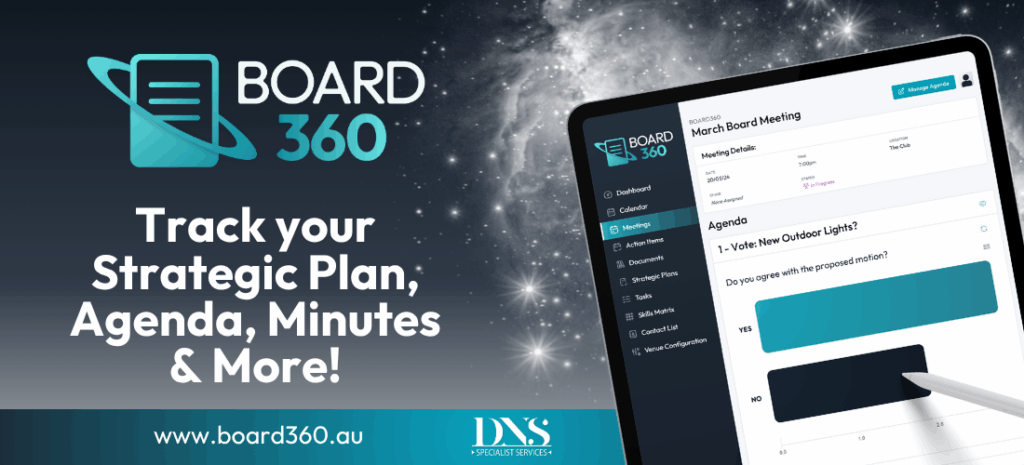
A challenge for many clubs is the lack of process for accountability on Strategic Plans and Corporate Governance. The Strategic Plan sits on a desk collecting dust, or on a shared server waiting to be saved over or accidentally deleted. Worse still, a new Board or Committee are appointed with no record of progress or discussions held.
Heads Up, Pubs & Clubs: Insolvency Rates on the Rise, What’s the Plan?
The Queensland hospitality scene is known for its vibrancy, but there’s a storm brewing on the horizon. Recent figures from the Australian Securities & Investments Commission (ASIC) show a worrying trend – insolvency rates across Australia are rising, and that means tougher times ahead for pubs and clubs.
Is Your Venue’s Constitution Aligned With The Latest Regulatory Changes?

Maximising the effectiveness of your club’s governance is vital for sustaining growth and ensuring smooth operations and compliance. As you navigate recent changes to the grievance and remuneration policies, it’s crucial to align your constitution accordingly to maintain compliance, transparency, and fairness.